
Qatar’s summer doesn’t ease up on equipment. Rooftop cabinets and tower enclosures can sit past 55°C in direct sun through July and August, and the battery bank backing up that site doesn’t get a break just because the grid does. If it wasn’t built for outdoor heat, it’s already on a shorter clock than the spec sheet says.
What “Outdoor-Rated” Actually Means
A lot of battery banks get treated as interchangeable when they’re not. An outdoor-rated system is built for the conditions it’ll actually sit in, not the conditions a datasheet assumes.
That means a sealed or IP-rated enclosure, some form of thermal management, battery chemistry that holds up above 40°C, and UV-resistant housing, because the Qatar sun degrades plastics and seals faster than most people expect. Pull a standard indoor VRLA battery out of an air-conditioned room and bolt it onto a tower cabinet, and what you’ve got isn’t an outdoor system. It’s an indoor battery with an outdoor problem.
Outdoor-Rated vs Standard Indoor Batteries: What’s the Real Difference?
This is where site specs go wrong most often, so it’s worth being exact about what separates the two.
Quick Comparison
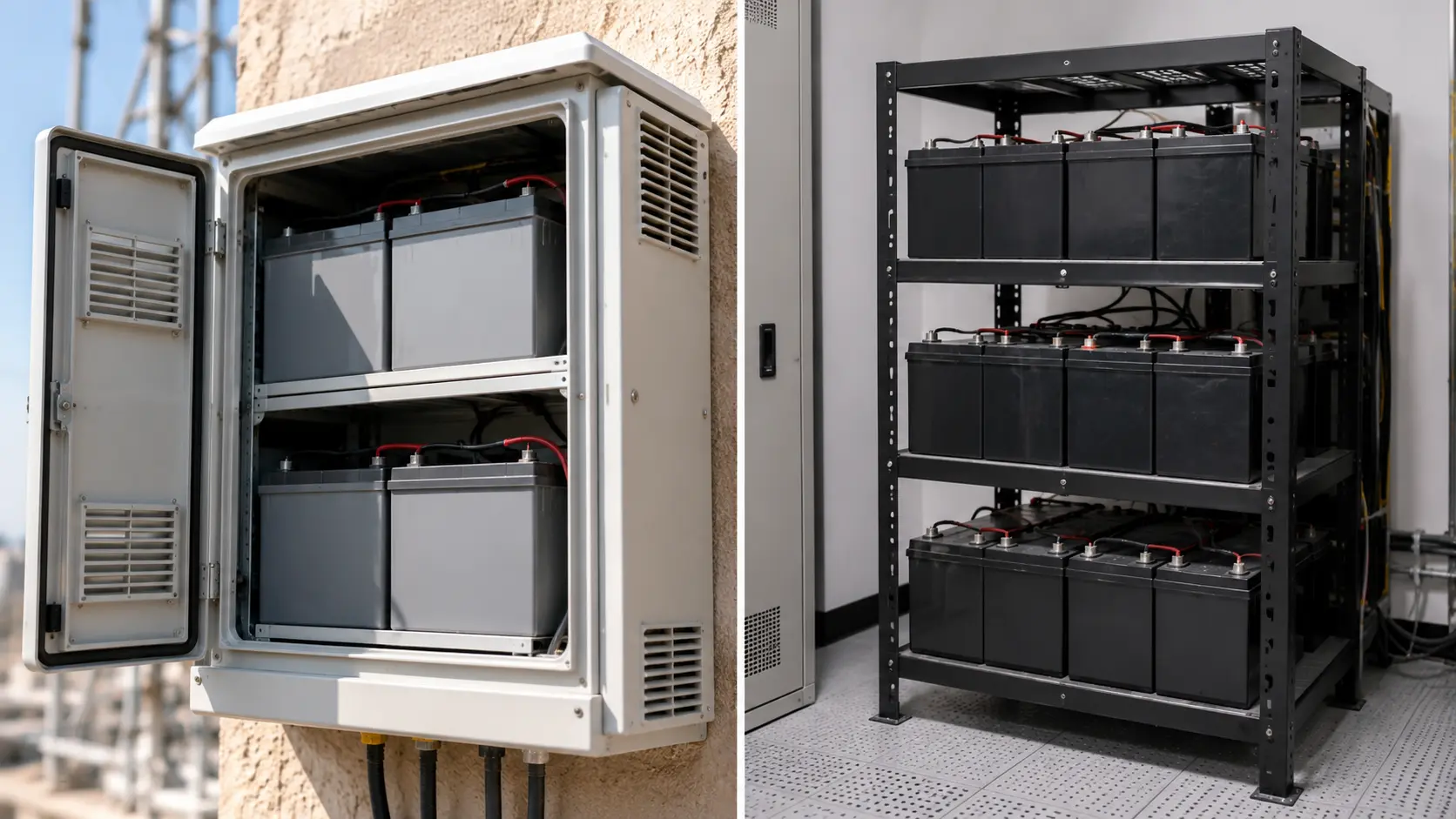
Standard indoor VRLA: Rated for a controlled 20–25°C environment. Sealed for indoor dust levels only. No UV protection. Designed around a room that’s already climate-controlled for it.
Outdoor-rated system: Rated for operation up to and beyond 45–50°C ambient. IP-rated enclosure against dust and moisture. UV-resistant housing. Built with the assumption that no climate control is coming.
Hybrid / retrofitted setups: Indoor battery plus an added enclosure and cooling. Workable, but only as good as the thermal management bolted on afterwards.
Why Heat Is the Real Enemy in Qatar
There’s a rough rule in the battery world: every 8–10°C above a battery’s rated temperature roughly halves its service life. A VRLA battery rated for 10 years at 25°C might not make it past 3–4 years on a Doha rooftop in summer. That gap catches people off guard more often than you’d think — the datasheet says one thing, the site does another.
For a telecom tower, that’s not just a battery replacement bill. It’s coverage risk. Towers carry cellular service, emergency comms, and a growing amount of IoT and smart-infrastructure traffic. When the grid drops and the backup battery has already been cooked by two summers of heat, the tower goes down at exactly the moment it’s needed.
Site Conditions That Make This Worse
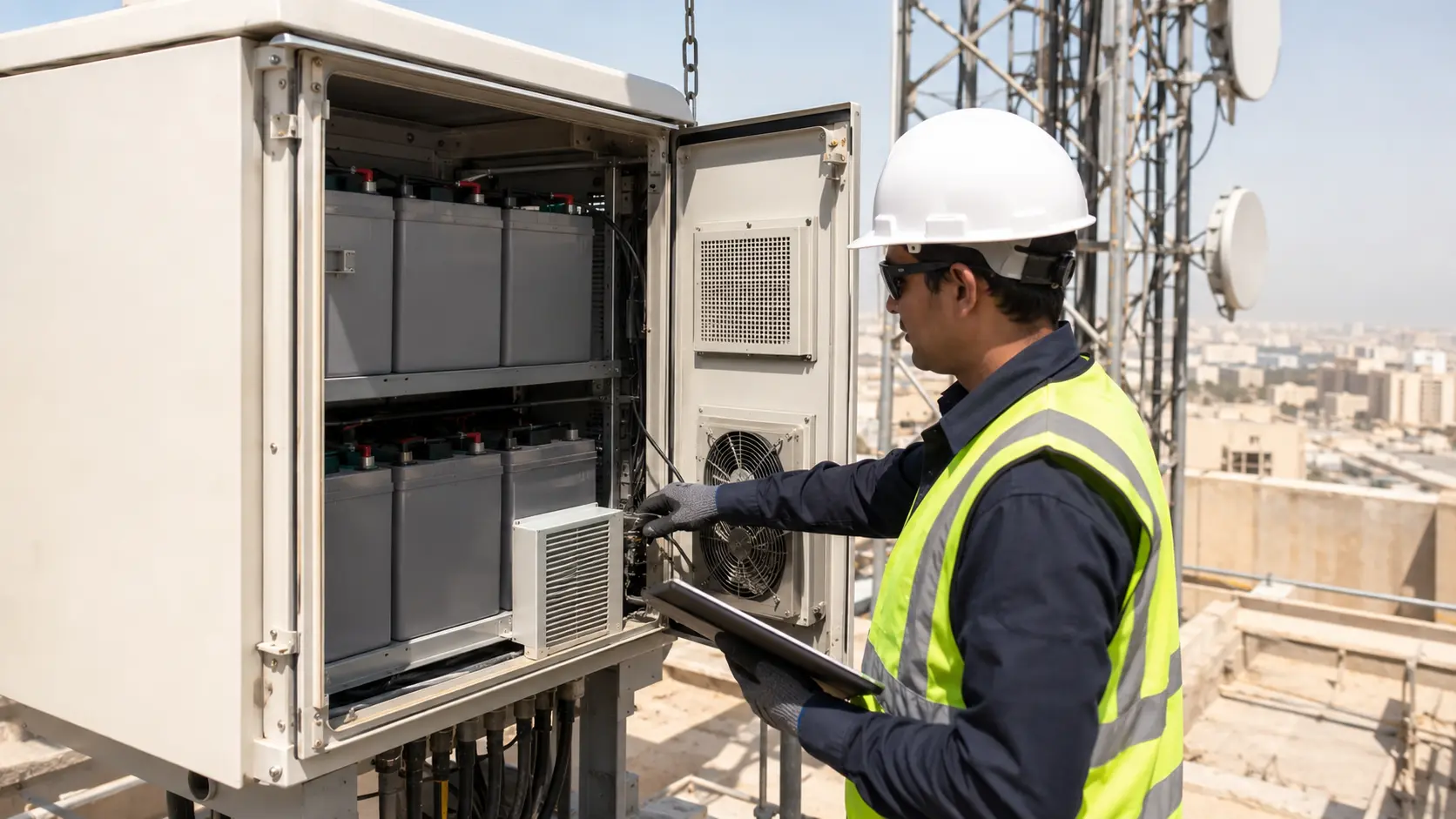
Unshaded rooftop cabinets, poor airflow around the enclosure, and sites without any active cooling all shorten the timeline further. A cabinet in full sun on a Doha rooftop can run 15–20°C hotter internally than the surrounding air, which pushes an already-marginal battery even further past its rated range.
Not sure whether your tower sites are actually running outdoor-rated systems or standard batteries in an outdoor enclosure?
Techlinqx engineers assess existing tower battery systems across Qatar and flag where the gap between spec and reality actually is.
Where This Actually Costs Money
Cutting corners on outdoor rating tends to look fine on the initial invoice. It shows up later, in a few places at once.
Replacement cycles every 2–3 years instead of 8–10. Truck rolls to remote sites for failures that shouldn’t be happening this early. Downtime penalties if an outage hits during a grid failure. And, worth saying plainly, swollen or leaking VRLA batteries in a poorly ventilated cabinet aren’t just a performance problem — they’re a fire risk.
What to Check Before Specifying a System
Installation Matters as Much as the Spec
Final Thoughts
Outdoor-rated battery systems aren’t a premium add-on for tower sites in Qatar – they’re the baseline requirement for keeping a site running through summer without surprise failures. The upfront cost of specifying and installing correctly is small next to the cost of replacing batteries every two years, sending trucks to remote sites, or losing coverage during an outage. Getting the spec and the installation right the first time is the cheapest path through a Doha summer, not the most expensive one.