
What Does N+1 Actually mean?
The formula is simpler than it sounds. ‘N’ is the number of components you need to run the facility at full load. ‘+1’ is one extra. That’s it.
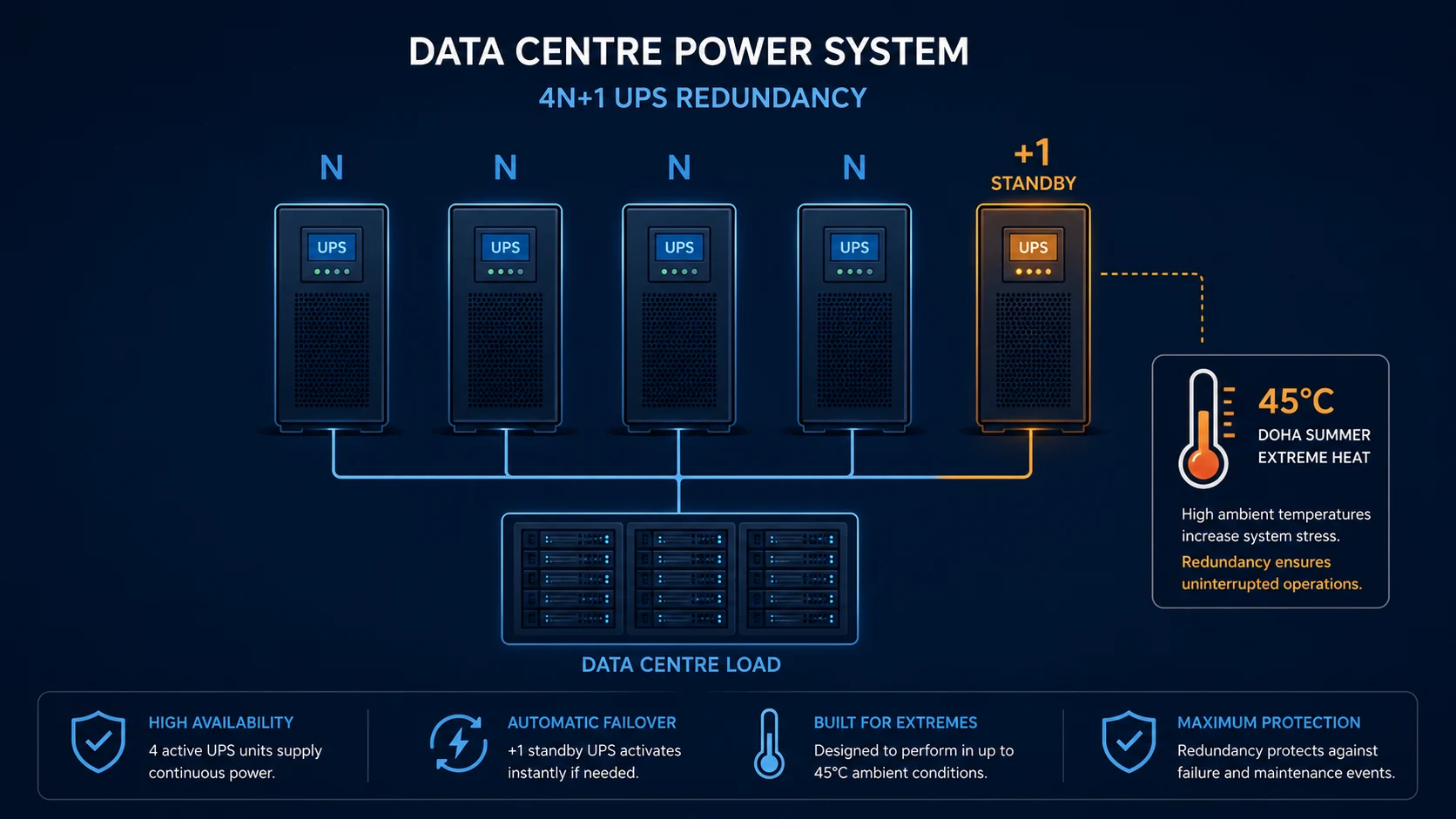
If your data centre needs four UPS units to handle peak load, N+1 means you install five. One trips, and the four remaining carry the load without interruption. No scramble. No downtime. The fifth unit was sitting there the whole time.
The same principle applies to cooling units, power distribution paths, generators, and network switches. One failure anywhere in the chain doesn’t take the room down.
In Tier 3 classification — the standard most serious Doha facilities are built to or working towards — N+1 isn’t the premium option. It’s the baseline requirement.
N+1 vs 2N: What’s the Real Difference?
This is where most facilities teams end up disagreeing, so it’s worth being exact.
N+1 means one spare across the total. N=4 gives you five components. Lose one — fine. Lose two at once — you’re exposed.
2N means full duplication. Every component is mirrored. N=4 gives you eight. Two completely independent systems running in parallel. You could lose half your infrastructure and keep operating. That’s the Tier 4 standard.
The cost difference is real. 2N costs more to build, more to power, and more to maintain. For most commercial data centres in Doha – banking, healthcare, and government – N+1 is the practical answer. 2N is for environments where the cost of any downtime is genuinely higher than the capital cost of doubling every system.
Quick Comparison
- N+1: One spare per system. Handles single-point failures. Standard for Tier 3.
- 2N: Full duplication. Handles concurrent failures. Required for Tier 4.
- N+2 / 2(N+1): Hybrid approaches for specific subsystems. Less common, higher cost.

Where N+1 Applies in a Data Centre
It’s not just UPS. N+1 runs across every critical subsystem in a properly designed facility.
Power Infrastructure (UPS)
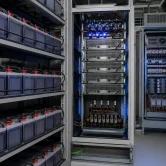
UPS redundancy is the most visible application. Your load requires four UPS modules; you install five. When one trips during a grid disturbance — and Qatar’s peak summer demand does cause them — the remaining four carry full load while the fifth is isolated and serviced. This is also where battery chemistry matters: a VRLA bank behaves differently under rapid switchover than a lithium system, and the N+1 design needs to account for that.
Cooling Systems
Precision air conditioning units (PACs) and computer room air handlers (CRAHs) run in N+1 configurations in any facility that takes uptime seriously. Doha makes this non-negotiable. An air handler failure in 45°C ambient heat isn’t a manageable incident — it’s a forced shutdown within minutes. One standby unit sitting on the same UPS feed changes that calculation completely.
Generators
For outages beyond UPS runtime, diesel generators provide extended backup. N+1 here means one generator above your rated load requirement. Facilities in Qatar’s industrial zones – Ras Laffan, the areas around Salwa Road – tend to have more variable grid reliability than central Doha, which makes generator N+1 more than a paper specification in those locations.
Power Distribution
PDUs, switchgear, and transfer switches are all candidates for N+1 configurations. The more complex the facility, the longer the list of subsystems this applies to. At a minimum, the transfer switches feeding critical loads should never be a single point of failure.
Not sure if your current facility is actually built to N+1?
Techlinqx engineers assess existing power infrastructure across Qatar and design N+1-compliant upgrades where the gap is real, not just on paper.
Why N+1 Matters More in Doha Than Most Places
Most redundancy textbooks were written for temperate climates. Qatar isn’t one.
Ambient temperatures in Doha regularly exceed 45°C in summer. This does two specific things to critical power infrastructure that a guide written for a Frankfurt or Chicago data centre won’t mention:
- Battery degradation accelerates significantly above 25°C. VRLA batteries rated for a 5-year design life in a controlled environment can see effective service lives of 2 to 3 years in Qatar without active thermal management. An N+1 UPS configuration with degraded standby batteries isn’t genuine redundancy — it’s a gap waiting to be exposed.
- Cooling systems run at or near rated capacity continuously through the summer months, not just during exceptional events. An N+1 cooling setup that would be comfortable headroom in a cooler climate is the actual operating baseline here. Any unit that goes down isn’t a minor fault — it shifts the full thermal load onto the remaining units at exactly the moment they’re already working hardest.
- Qatar’s infrastructure development pace adds another layer. A lot of data centres here were commissioned quickly to support smart city projects, banking infrastructure, and government operations. Not all of them were designed with the redundancy levels that 2025’s and 2026’s demands actually require. Retrofitting N+1 after a facility is live is possible but expensive. Specifying it correctly in the design stage — during data centre solutions planning in Qatar — is the cheaper option, by a significant margin.
- KAHRAMAA’s supply standards and IEC-compliant installations are the baseline expectation in Qatar. But compliance with the supply standard doesn’t equal redundancy. A facility can pass every KAHRAMAA requirement and still have a single UPS bank with no standby. The compliance question and the redundancy question are separate.
What N+1 Doesn’t Protect You From
N+1 covers single-point hardware failure. That’s a specific thing, not everything. Here’s what it doesn’t cover:
- Concurrent failures.Two components failing at the same time. Unlikely, but Qatar’s summer heat — when cooling units are already stressed and batteries are already degraded — makes it less unlikely than the design assumption.
- Site-wide events. If the utility supply drops and takes the whole facility simultaneously, N+1 at the component level doesn’t help. That requires a different layer of redundancy upstream.
- An untested standby. A spare that has never been load-tested is an assumption, not a guarantee. N+1 with a failed standby is N+0. Quarterly functional tests and annual load-transfer tests aren’t optional — they’re what makes the design real.
- Design mismatches.Specifying N+1 on paper but sourcing standby components with different load ratings or incompatible battery chemistries can make the redundancy theoretical. The fifth UPS module needs to match the four it’s backing up.
An N+1 design that’s been correctly sized for Qatar’s climate, installed to IEC standards, and maintained with active monitoring works. One that was included in the design document to satisfy a checklist and never tested properly isn’t redundancy — it’s paperwork.