
A UPS battery doesn’t usually fail with a warning. One day it’s holding charge; the next it’s not — and you find out at the worst possible moment, mid-outage, when the load you thought was protected just isn’t. If you’re trying to catch the signs your UPS battery needs replacing before it fails you, the good news is there usually are signs. Most people just don’t know what to look for until it’s too late.
Battery failure isn’t sudden in the way it feels. It’s a slow decline that finally crosses a line. Reduced runtime, longer recharge cycles, a battery that feels warm when it shouldn’t — these show up weeks or months before total failure, if you’re checking.
This guide covers what those warning signs actually look like, why Qatar’s heat speeds up the timeline, and when replacement beats waiting it out.
What Battery Decommissioning Actually Means
Decommissioning a battery isn’t the same as disposing of one. Disposal is the final step. Decommissioning is everything that comes before it.
It starts with taking the battery out of active service — disconnecting it from the load, discharging it safely, and removing it from its rack or cabinet. From there, the battery needs to be assessed for condition, categorised by chemistry and hazard level, stored correctly if it can’t be collected immediately, and then handed to a licensed handler for disposal or recycling.
For a single UPS battery in an office, this is relatively simple. For a large data centre battery room — dozens of VRLA strings, each holding hundreds of kilograms of lead and sulphuric acid — it’s a coordinated engineering operation.
The distinction matters because skipping steps creates risk. A battery that’s disconnected but not properly discharged can still deliver enough current to cause a serious electrical injury. One that’s stored in a warm room past its safe holding window starts to degrade—and VRLA batteries that degrade in storage can swell, leak acid, or, in rare cases, vent gas that creates fire risk.
Why Qatar Makes This More Complex Than You’d Expect
Qatar’s regulatory environment treats industrial batteries as hazardous waste from the moment they leave active service. That’s the right call — because they are. But it means you can’t just ring a general waste contractor and expect them to handle a decommissioned UPS bank correctly.
Under Qatar’s Law No. 30 of 2002 on the Protection of the Environment, hazardous waste must be handled, transported, and disposed of by licensed entities. Battery decommissioning that doesn’t end with a licensed collector is non-compliant — regardless of what happens to the battery after collection.
There’s also a climate factor. Qatar’s summer temperatures regularly exceed 45°C. Batteries that are decommissioned and left in storage – in plant rooms, equipment yards, or outdoor enclosures – deteriorate faster than they would in a temperate climate. A VRLA battery that would safely hold for several weeks in a European warehouse might start presenting risks within days in a poorly ventilated Doha store.
That creates pressure to move decommissioned batteries quickly. Facilities that don’t have a pre-arranged collection service in place often find themselves holding hazardous material longer than is safe or legal.
Which Battery Types Require Formal Decommissioning
All industrial battery chemistries used in Qatar’s infrastructure carry some decommissioning obligation. The level of complexity varies:
| Battery Type | Main Hazards | Decommissioning Complexity |
|---|---|---|
| VRLA (AGM & Gel) | Lead, sulphuric acid | Medium — most common; specialist collection required |
| Nickel-Cadmium (Ni-Cd) | Cadmium (carcinogen), nickel | High — MME strict guidelines; no standard waste stream |
| Lithium-Ion (LiFePO4) | Lithium, electrolyte, thermal risk | High — fire risk if damaged; must be assessed before collection |
| Flooded Lead-Acid | Lead, sulphuric acid, hydrogen gas | High — venting risk; specific discharge protocol required |
| Motive Power (Forklift) | Lead, sulphuric acid | Medium-High — large volumes; careful handling at scale |
Ni-Cd batteries consistently present the highest risk profile at decommissioning. Cadmium is a listed carcinogen under international environmental law, and Qatar follows Basel Convention guidelines that prohibit uncontrolled disposal. Facilities that have Ni-Cd installations — common in older telecom towers and outdoor backup
systems — need to ensure their decommissioning process includes specific documentation of cadmium handling.
The Correct Decommissioning Process — Step by Step
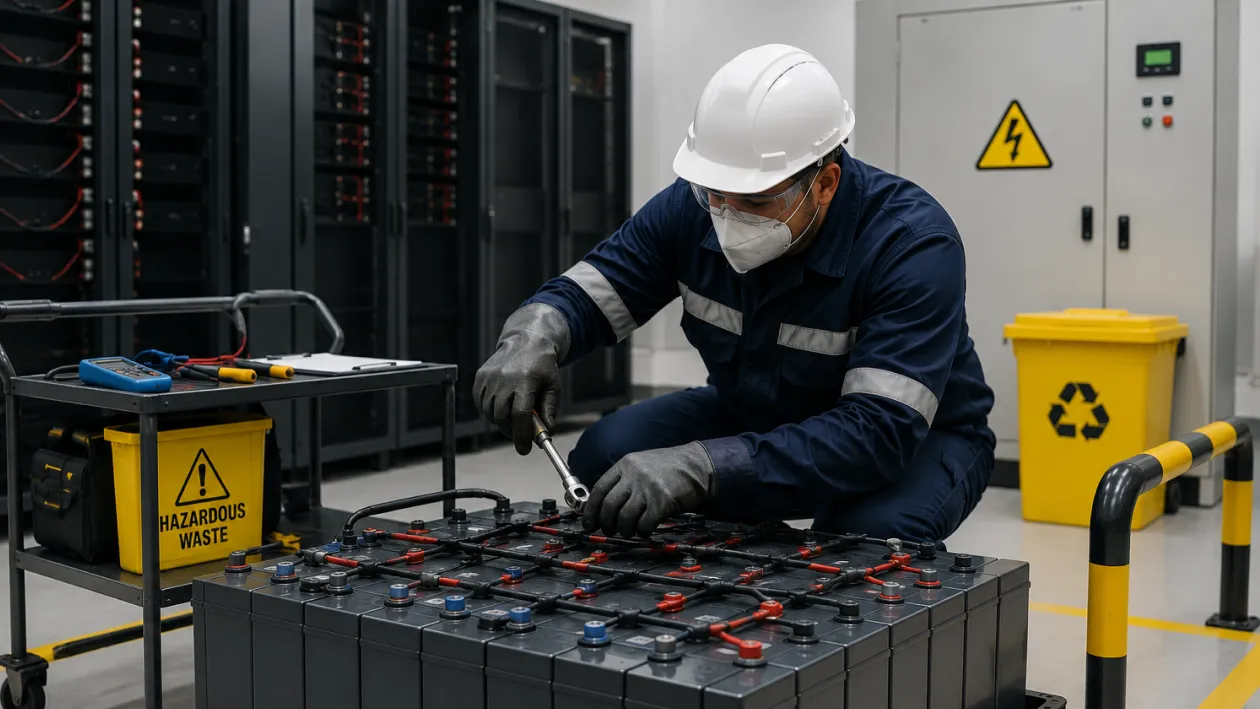
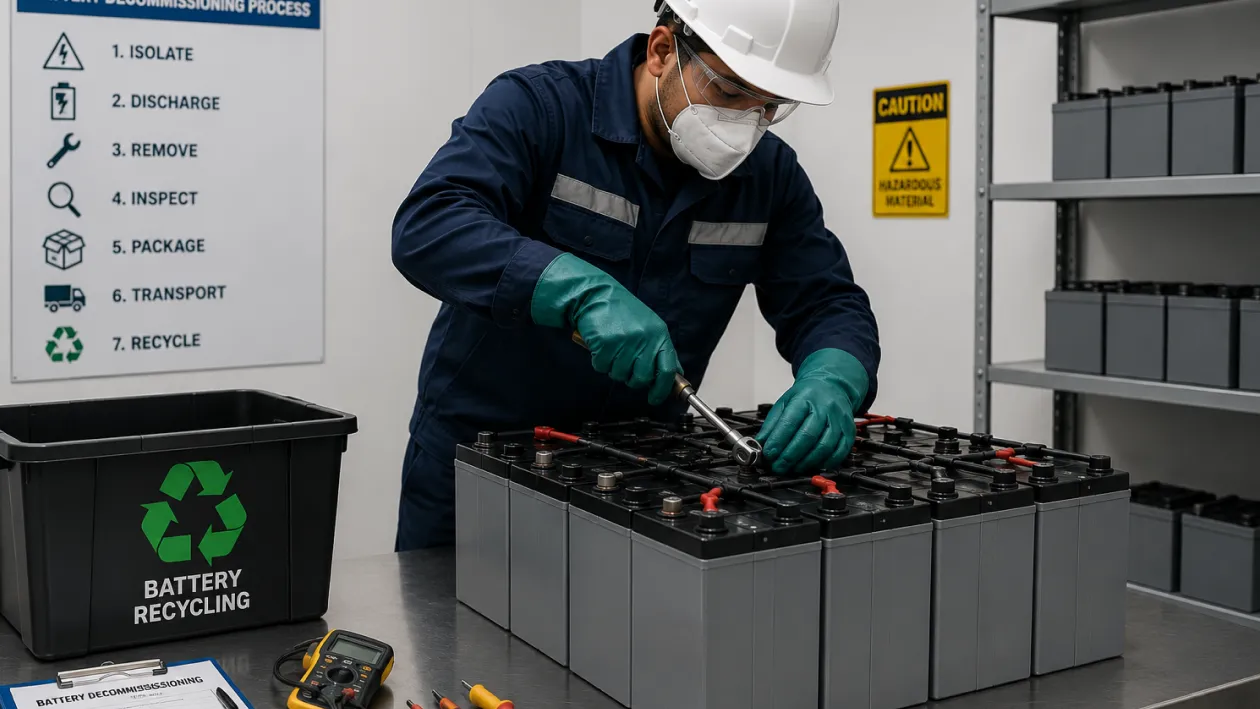
A proper decommissioning process covers six stages. Skipping any of them creates either a safety risk, a compliance gap, or both.
Step 1 — Take the battery out of service
Before any physical work begins, take the battery off load. For a UPS, this means switching to bypass and confirming the load is protected by an alternative source before disconnecting the battery string. Don’t start disconnecting live.
Step 2 — Discharge and Isolate
A battery coming out of a float charge state still holds significant charge. Discharge it safely before removal. Isolate the battery circuit, confirm voltage is at a safe level, and then disconnect terminals. Always disconnect negative before positive.
Step 3 — Inspect and Document
Physically inspect every battery in the string. Note swelling, leaks, cracks, or corrosion. A battery showing these signs requires more careful handling — it may need to be individually bagged or contained before it can be moved. Document battery type, serial numbers, quantity, and condition. This documentation becomes part of your compliance record.
Step 4 — Safe Storage if Collection Isn’t Immediate
If collection can’t happen same-day, batteries need to go into appropriate interim storage. Upright, in a ventilated area, away from heat sources, with containment in place in case of leaks. In Qatar’s climate, keep storage periods as short as possible.
Step 5 — Arrange Licensed Collection
Contact an MME-licensed battery handler to arrange collection. Make sure they can provide disposal documentation — a certificate or manifest confirming the batteries were collected and processed correctly. Without this, you have no compliance record.
Step 6 — File Your Records
Keep disposal documentation on file. Qatar’s regulatory environment is tightening, and ESG audits increasingly require evidence of compliant disposal going back multiple years. A missing disposal record from two years ago can still create a compliance problem today
Common Mistakes Facilities Make
The same problems show up repeatedly in facilities across Qatar:
| Mistake | Why It Matters |
|---|---|
| Leaving decommissioned batteries in storage for months | Heat degrades batteries faster than expected; what was safe to store becomes a leak or fire risk |
| Using a general waste contractor | Not equipped for hazardous battery material; creates a compliance gap even if the battery is eventually disposed of |
| No discharge before removal | Creates live electrical risk during handling, also a safety issue for the collection team |
| No documentation of disposal | Leaves you exposed in audits, ESG reviews, and insurance assessments |
| Assuming disposal = decommissioning | Disposal is the final step, not the whole process; skipping earlier steps creates risk before you get there |
How Decommissioning Connects to ESG and Compliance
Battery decommissioning isn’t just a facilities management issue. For organisations with ESG reporting obligations, it’s increasingly a governance issue.
Sustainability frameworks — including GRI standards and Qatar’s own Vision 2030 sustainability goals — call for evidence of responsible hazardous material management. A facility that can’t demonstrate compliant battery disposal has a visible gap in its environmental reporting.
Insurance is another pressure point. Some industrial insurers are starting to ask for hazardous waste management records as part of policy renewal. A decommissioning process that doesn’t produce documentation creates exposure beyond the regulatory risk.
The companies best positioned on this are the ones that treat decommissioning as a planned event, not an emergency. They have collection partners in place before batteries reach end of life, and they know exactly what documentation they’ll need to produce.
What is battery decommissioning?
Battery decommissioning is the process of safely removing an industrial battery from active service. It includes taking the battery of load, discharging it, inspecting and documenting its condition, storing it safely if needed, and arranging collection by a licensed hazardous waste handler.
Is battery decommissioning required by law in Qatar?
Yes. Under Qatar’s Law No. 30 of 2002 on the Protection of the Environment, industrial batteries are classified as hazardous waste and must be handled, transported, and disposed of by licensed entities. Decommissioning that ends without licensed collection is non-compliant.
How long can I store a decommissioned battery in Qatar?
As short a time as possible. Qatar’s heat accelerates battery degradation — a VRLA battery that might safely store for weeks in a cooler climate can start presenting leak or gas-venting risks much sooner in Qatar’s summer temperatures. Pre-arrange collection before decommissioning if you can.
What documentation do I need for battery decommissioning in Qatar?
You need an inspection record covering battery type, quantity, and condition, plus a disposal certificate or manifest from an MME-licensed waste handler confirming the batteries were collected and processed correctly. Keep these records for at least three to five years.
Techlinqx handles battery decommissioning across Qatar — from site assessment and safe removal through to licensed collection and compliance documentation. Whether you’re decommissioning a single UPS cabinet or clearing an entire battery room, we manage the process end to end.
Find out more:
How Techlinqx Can Help
Techlinqx provides battery decommissioning support across Qatar — covering all battery types used in data centres, telecom infrastructure, industrial facilities, and commercial buildings.
We start with a site assessment: what batteries you have, their condition, and any specific handling requirements. From there, we coordinate safe removal, interim storage if needed, and licensed collection. You get full documentation at every stage — inspection records, collection manifests, and disposal confirmation.
If you’re replacing batteries as part of the decommissioning, we handle new battery supply and installation at the same time. One team, one engagement, no gap between the old system coming out and the new one going in.
Final Thoughts
Battery decommissioning is one of those things that looks simple until it isn’t. A battery coming out of a data centre isn’t just old equipment — it’s lead, acid, and in some cases, cadmium in a country where those materials are regulated from the moment they leave active service.
The facilities that handle this well aren’t doing anything complicated. They treat decommissioning as a planned process rather than an emergency, they have a licensed collection partner in place, and they keep the paperwork. That’s it.
The facilities that get caught out are the ones that wait until a battery is already out of service before thinking about what comes next.