
A UPS battery doesn’t usually fail with a warning. One day it’s holding charge; the next it’s not — and you find out at the worst possible moment, mid-outage, when the load you thought was protected just isn’t. If you’re trying to catch the signs your UPS battery needs replacing before it fails you, the good news is there usually are signs. Most people just don’t know what to look for until it’s too late.
Battery failure isn’t sudden in the way it feels. It’s a slow decline that finally crosses a line. Reduced runtime, longer recharge cycles, a battery that feels warm when it shouldn’t — these show up weeks or months before total failure, if you’re checking.
This guide covers what those warning signs actually look like, why Qatar’s heat speeds up the timeline, and when replacement beats waiting it out.
Why UPS Batteries Fail Without Warning
A UPS battery doesn’t go from fine to dead in one step. It degrades — capacity drops a little at a time, internal resistance climbs, and the battery quietly gets worse at the one job it has: holding charge under load.
The reason it feels sudden is that most facilities only find out during a real power event. The battery looks fine sitting on float charge. It’s only when the grid actually drops and the battery has to deliver a full load that the degradation shows up — and by then it’s not a maintenance conversation anymore; it’s an outage. This is why waiting for a visible problem is the wrong strategy. The visible problem is the outage.
7 Signs Your UPS Battery Needs Replacing
Most of these show up gradually. Catch two or three together and it’s worth acting on.
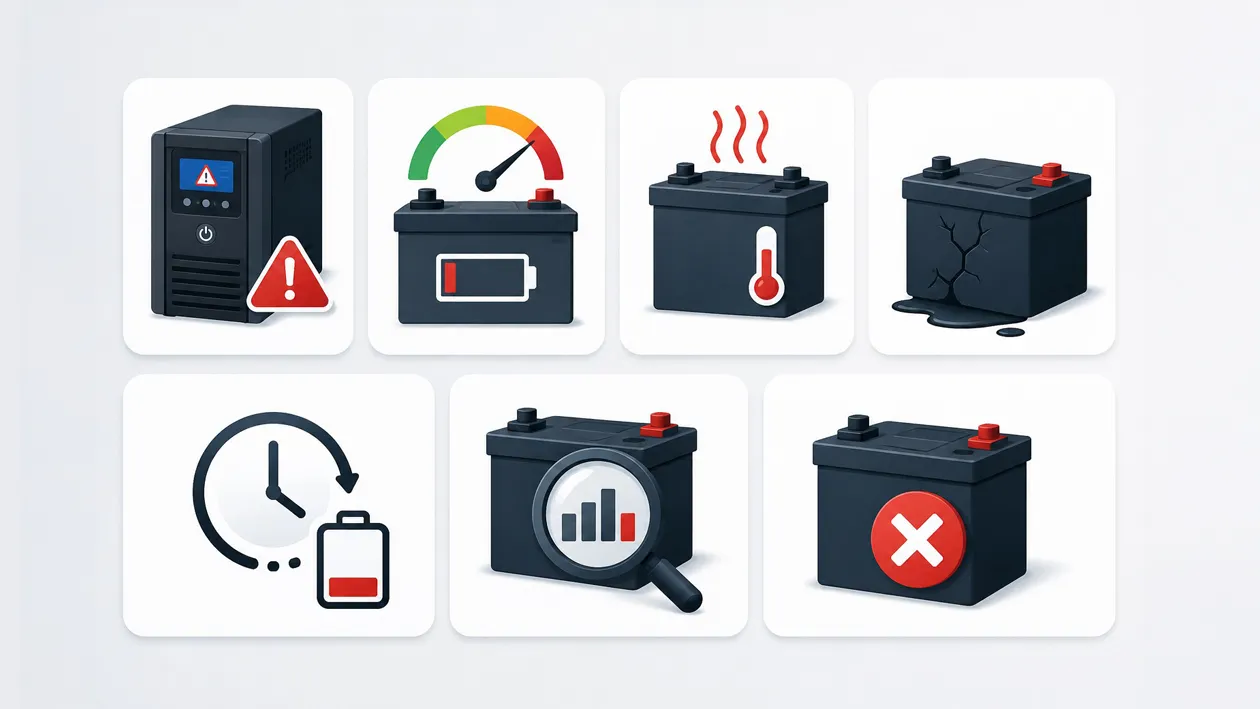
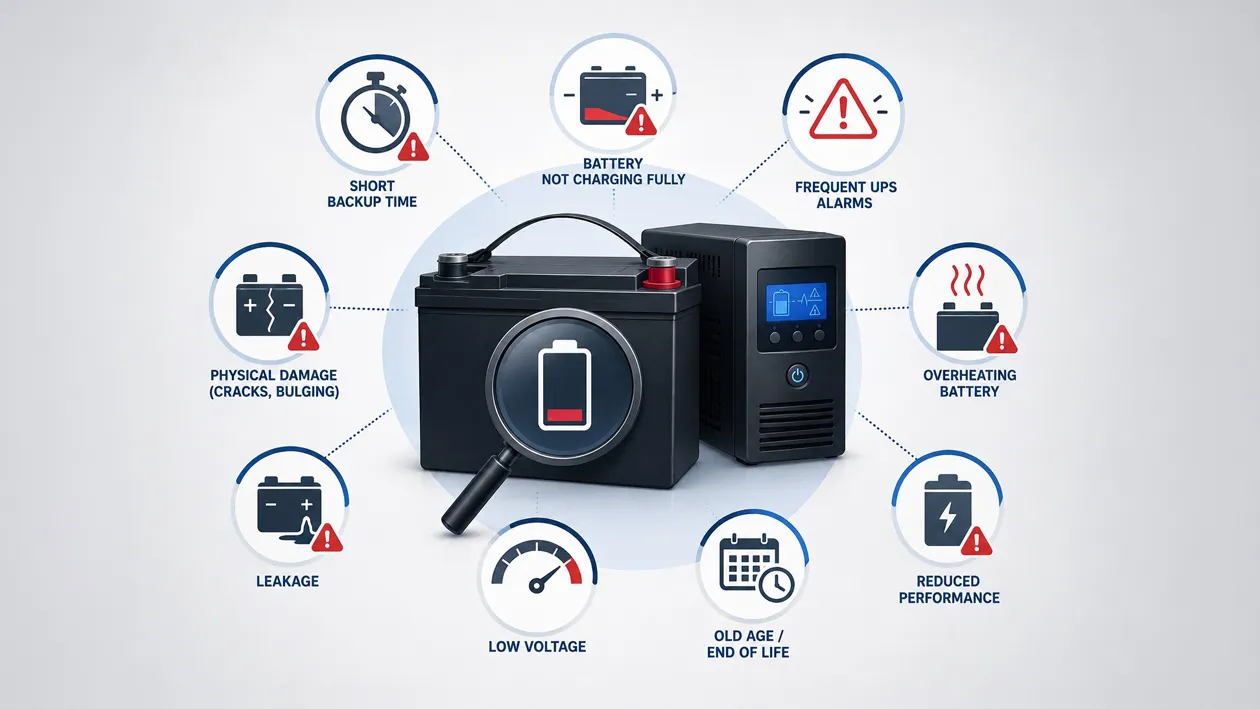
Reduced runtime on battery power
If your UPS used to hold a load for 15 minutes and now it’s down to 6, that’s not normal wear — that’s a battery that lost a meaningful share of its capacity. Runtime drop is usually the first sign anyone notices, because it’s the one that actually gets tested.
Battery alarms or warning indicators
Most UPS units flag a “replace battery” or “battery fault” warning well before total failure. It’s tempting to dismiss this as overly cautious firmware. It usually isn’t.
Swelling or a bulging case
Heat and overcharging cause internal gas buildup in VRLA batteries, and the case swells to accommodate it. A swollen battery is a battery that’s already failing internally and is a safety risk, not just a performance one.
A burning or sulphur smell near the battery cabinet
This points to internal breakdown, sometimes a thermal event in progress. Don’t wait on this one. Isolate the unit and get it inspected immediately.
The battery feels noticeably warm to the touch
A healthy battery on float charge should be close to ambient temperature. Persistent warmth — especially if one battery in a string is hotter than the others — usually means internal resistance has climbed and the battery is working harder than it should just to hold charge.
Longer recharge times after a discharge event
A battery in good condition recharges to full within a predictable window. If recharge is taking noticeably longer than it used to, the battery’s ability to accept charge is degrading.
The battery is past its design life for Qatar’s climate
Even with no obvious symptoms yet, age alone is a signal. VRLA batteries rated for 5 years at 25°C don’t get 5 years in Qatar.
How Qatar’s Climate Shortens Battery Life
VRLA battery life ratings are calculated at 25°C. For every 8-10°C above that, expected lifespan roughly halves – a rule that’s held up across most VRLA manufacturer datasheets for decades.
Qatar’s ambient temperatures sit well above 25°C for most of the year, and battery cabinets in plant rooms or outdoor enclosures often run hotter still. A VRLA battery rated for 5 years at standard conditions might realistically deliver 2-3 years in a poorly ventilated Doha plant room.
This isn’t a flaw in the equipment. It’s physics, and it means the replacement schedule that makes sense for a temperate climate is too conservative for Qatar. Facilities that go by manufacturer-rated lifespan alone, without adjusting for actual ambient conditions, are the ones most likely to get caught out by a battery that fails earlier than expected.
How to Test a UPS Battery Before It’s Too Late
Waiting for visible symptoms means waiting for the battery to already be in trouble. Testing catches the decline earlier.
- Step 1 — Check Manufacturer Warning Indicators. Most modern UPS systems log battery health and flag warnings well before failure. Check this regularly, not just when something seems off
- Step 2 — Run a Load Bank Test. A load bank test puts the battery under actual discharge conditions and measures real runtime against rated capacity. This is the only way to know true remaining capacity — float voltage alone doesn't tell you enough.
- Step 3 — Measure Internal Resistance. Rising internal resistance is one of the earliest indicators of battery degradation, often showing up before runtime loss becomes obvious on a basic check.
- Step 4 — Inspect Physically. Look for swelling, corrosion at the terminals, leakage, or discolouration. Any of these on inspection is reason enough to schedule replacement, regardless of what the electrical tests say.
- Step 5 — Track Trends, Not Single Readings. One slightly off reading isn't a crisis. A battery whose capacity has been dropping consistently over three or four test cycles is telling you something. Trend data matters more than any single test.
Replace or Repair — How to Decide
| Situation | Recommended Action |
|---|---|
| Single battery in a string showing weakness | Replace the affected battery, but check the rest of the string too. |
| Whole string past design life for Qatar’s climate | Plan full string replacement, even if symptoms aren’t visible yet. |
| Swelling, leakage, or smell | Replace immediately — do not attempt to keep in service. |
| Reduced runtime, otherwise healthy-looking | Run a load bank test before deciding — don’t guess. |
| Battery under warranty with early failure | Contact supplier before replacing — may be covered. |
Mixing old and new batteries in the same string is rarely a good idea. A weaker battery drags down the whole string’s performance, and the new battery ages faster trying to compensate. If one battery in a string is failing and the rest are close behind on age, replacing the full string is usually the more reliable call.
What Happens If You Wait Too Long
The cost of ignoring early warning signs isn’t just a dead battery. It’s what the dead battery was protecting.
- Unprotected load during the next grid failure — servers, medical equipment, production lines, whatever the UPS exists to back up.
- Emergency replacement at a higher cost than a planned one, often with rushed logistics and limited stock options.
- Downtime that's measured in lost operations, not just a battery line item.
- Risk to other equipment if a battery fails physically – swelling, leakage, or, in rare cases, thermal events that can damage the UPS itself.
A battery replacement that’s planned costs less, takes less time, and causes zero disruption. A battery replacement that’s forced by failure costs more on every count.
How Techlinqx Can Help
Techlinqx supplies and installs UPS batteries across Qatar — VRLA, lithium-ion, and Ni-Cd — matched to your existing UPS and charging system. We also carry out battery health assessments, including load bank testing, so you know where your battery actually stands rather than guessing from age alone.
If testing shows a battery or string needs replacing, we handle the full job — supply, removal of the old battery, installation, terminal torque verification, and float charge testing before we leave. If you’re not sure whether it’s a single battery or the whole string, we’ll tell you honestly after testing, not before.
Final Thoughts
A failing UPS battery gives you signs before it gives you an outage. Reduced runtime, warning alarms, a warm battery, a swollen case — none of these come out of nowhere, and none of them should be ignored until the grid actually drops and the battery can’t deliver.
In Qatar’s climate, batteries age faster than their datasheets suggest. The safest approach isn’t waiting for a symptom – it’s testing on a schedule and replacing on capacity, not just on calendar age.
If your UPS battery is showing any of the signs above, or it’s simply been in service for a few years in Qatar’s heat, get it tested. The alternative is finding out the hard way, mid-outage, when there’s nothing left to do but wait it out.
FAQ
How long do UPS batteries last in Qatar?
What's the first sign a UPS battery is failing?
Is a warm UPS battery dangerous?
Can I replace just one battery in a string, or does the whole string need replacing?
Does Techlinqx test UPS batteries before recommending replacement?
Worried Your UPS Battery Is on Its Way Out?
Techlinqx supplies, tests, and installs UPS batteries across Qatar — with load bank testing to confirm exactly where your battery stands.