
Picture this. You are running a facility in Doha. It is July. Outdoor temperatures are sitting above 50°C. Somewhere inside your server room, a rack is running hotter than it should. Nobody noticed. Three days later, you have a failed storage array and a very unhappy operations team. This is not a hypothetical. It happens. And almost every time, the root cause is not the hardware. It is how the data centre cooling systems were managed, or how they were not.
Here is what actually works and why getting this right matters more than most facility managers want to admit.
Why Qatar Changes Everything About Cooling Strategy
Standard cooling guidelines were largely written for temperate climates. The assumptions baked into those specifications, ambient temperature ranges, building envelope performance, and mechanical plant sizing simply do not translate to a Gulf context.
A server room in Manchester runs differently from one in Doha. That is not an opinion. The heat load on your cooling plant is higher. The risk of thermal excursion during a partial system failure is greater. And the margin for error is narrower than most vendors will tell you upfront.
Techlinqx builds data centre infrastructure specifically sized for Qatar’s actual conditions, not for a European temperature standard. That distinction matters when you are sizing CRAC units, specifying chilled water plant capacity, or deciding how much cooling redundancy your facility actually needs.
CRAC vs CRAH: Stop Guessing, Start Matching
Two technologies dominate precision cooling in commercial data centres, and they serve genuinely different purposes.
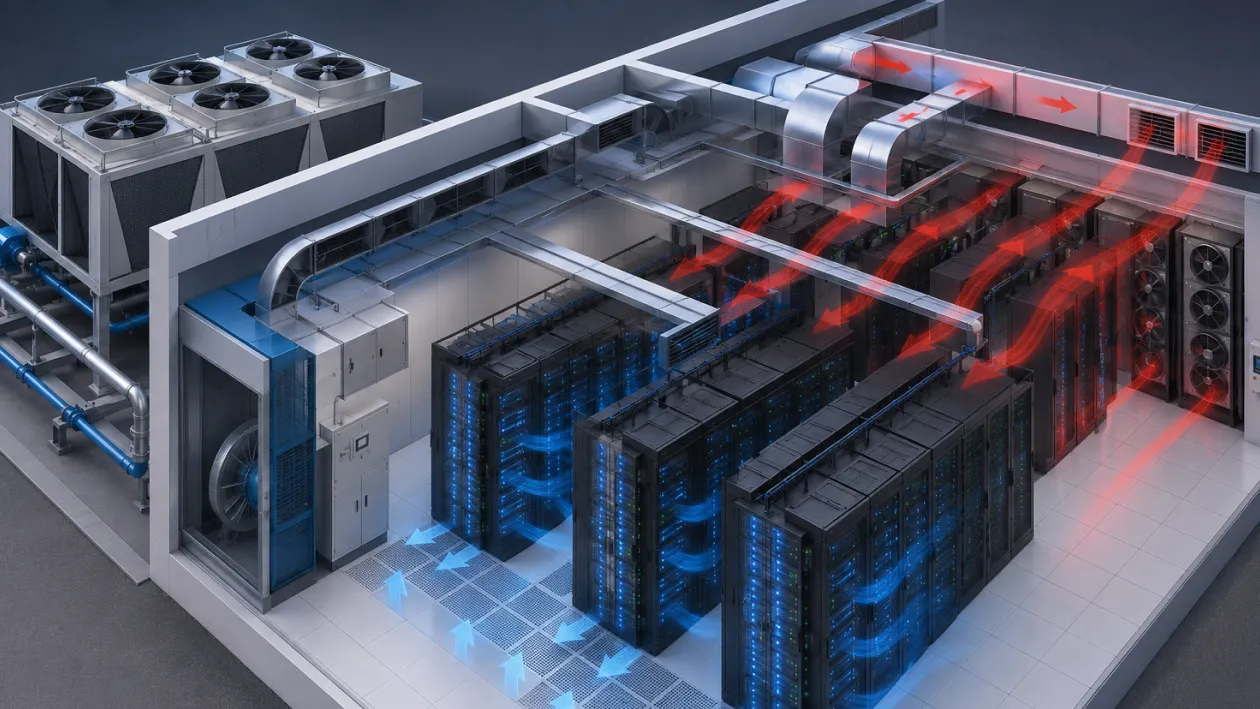
CRAC units use a direct expansion refrigerant cycle. They are self-contained, fast to commission, and well suited to small and mid-size deployments where rack density is moderate. They respond quickly to temperature spikes, which is useful in dynamic load environments.
CRAH systems connect to a chilled water loop from a central plant. They handle scale better, manage sustained high-density loads more efficiently, and integrate naturally into larger mechanical infrastructure. For enterprise-grade or government facilities running 24 hours a day, CRAH is usually the right long-term call.
The mistake most operators make is choosing based on upfront cost rather than total load profile. An undersized unit runs at full capacity constantly. It wears faster, fails sooner, and costs more to operate over its lifetime than a correctly specified unit ever would.
Hot Aisle Containment Is Not Optional at High Density
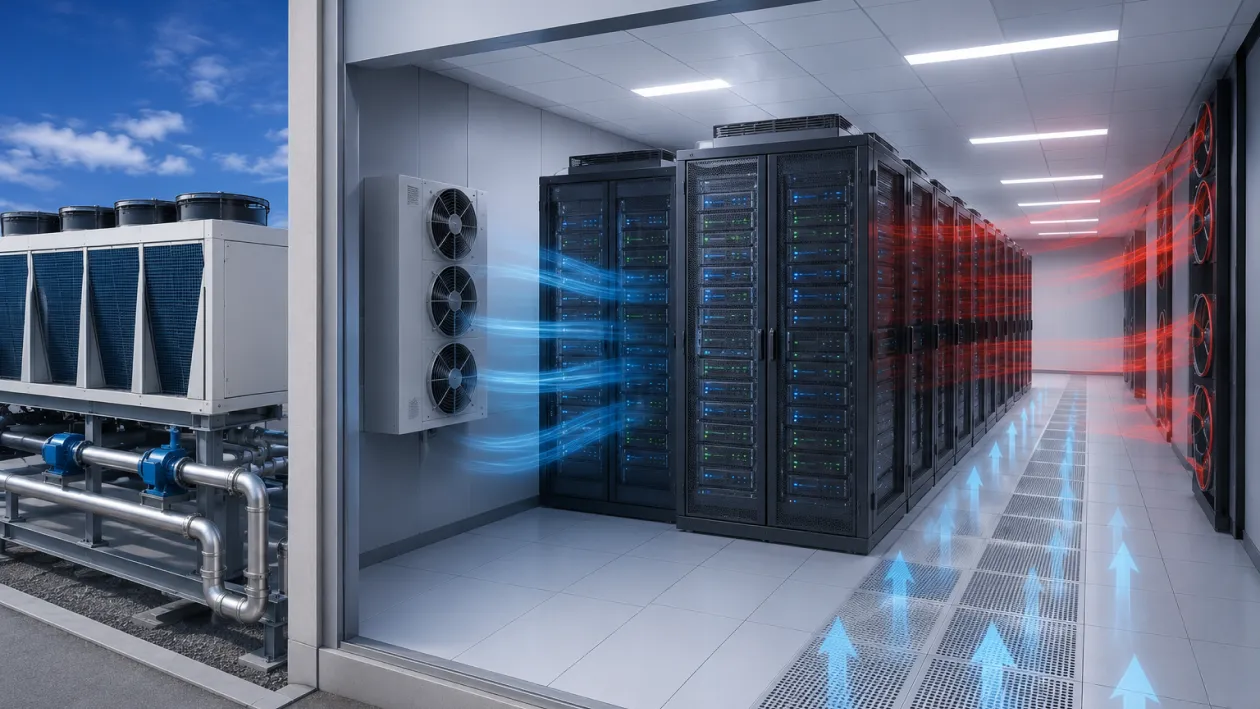
Server racks exhaust heat from the back. They draw cool air in from the front. When those two airstreams mix in an open-floor plan, your cooling units have to work significantly harder to compensate for what is effectively self-inflicted inefficiency.
Hot aisle containment captures exhaust air directly and routes it back to the cooling return path without letting it recirculate. Cold aisle containment keeps supply air focused on server intakes. Both approaches reduce the recirculation problem. Combining them is the standard for any high-density environment.
The efficiency improvement from proper containment shows up directly in your power usage effectiveness score. Facilities that implement containment well consistently achieve better PUE results than those relying on open floor cooling, regardless of how capable the underlying cooling equipment is.
Blanking panels in unused rack slots are part of this same logic. Gaps in rack face panels allow recirculation within the rack itself, which defeats the purpose of containment above it.
Real-Time Visibility Through DCIM Monitoring
Good cooling infrastructure managed without visibility is still a liability. You need to know what is actually happening across your facility, not what you assume is happening based on quarterly audits.
Data centre infrastructure management platforms give operations teams live dashboards covering thermal conditions, power draw, and equipment status across the entire floor. Automated alerts flag anomalies before they escalate. Capacity planning tools show where you are trending before you run out of headroom.
Techlinqx deploys DCIM monitoring platforms in Qatar that combine real-time dashboards with automated alerting and asset tracking, giving facility teams the operational visibility they need to catch problems early rather than respond to them after the fact.
For any facility running mission-critical workloads, this layer of management is not a bonus feature. It is what separates proactive operations from reactive ones.
What Day-to-Day Cooling Management Actually Looks Like
There is a difference between having good cooling infrastructure and managing it well. Here is what the operational side should include:
Thermal audits at rack level, not just room level, done regularly enough to catch hotspots before they cause damage. Filter changes and refrigerant checks on a scheduled cycle, not when performance degrades. Airflow reassessment any time rack layout, load density, or equipment configuration changes. And power infrastructure review alongside cooling review, because a poorly distributed power load generates uneven heat that no containment strategy fully compensates for.
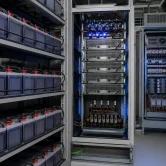
Techlinqx handles UPS and battery integration alongside precision cooling, which matters because power and thermal management are not independent problems. Clean, redundant power distribution feeds directly into a more stable thermal environment.
Final Thoughts on Data Centre Cooling Systems
Managing data centre cooling systems is an ongoing discipline, not a commissioning task you complete once and revisit when something breaks. The stakes are high. Hardware failure, data loss, and operational downtime all trace back to thermal management failures more often than most post-incident reports acknowledge.
If you are running a facility in Qatar and you are not certain whether your cooling infrastructure was sized for actual local conditions, that is worth finding out sooner rather than later.
When did you last do a proper thermal audit of your facility, rack by rack? If the answer is “a while ago,” that is where to start.